Commercial Analysis
Sep 24, 2026 11 min read

Commercial vs Residential: What Changes the Net Return

In Q2 2026 Dubai office rents rose 13% year on year while residential rents fell 2.6%. That single pair of numbers is being used to sell offices as the better asset, full stop — and it does not support that conclusion. Rents moving is not a return on capital, and the yield advantage that does exist lives in a specific part of the office market, not across it. What follows is where the gap is, where it is not, and the four mechanics that change a net return on a commercial purchase: VAT, operating costs, corporate tax and liquidity.

Commercial vs Residential: What Changes the Net Return

There is a true sentence about Dubai offices and a false one, and they are one word apart.

True: offices in the secondary and value-add segment — JLT, Al Quoz, Business Bay — are estimated at 7–10% gross against roughly 6.9% for residential. False: offices out-yield homes. In prime locations such as DIFC the gap is somewhere between minus 0.4 and plus 0.6 percentage points, which is no gap at all. The advantage is a property of one part of the office market, and the part it belongs to is the part nobody puts in a brochure.

Below: where the gap lives, then the four mechanics — VAT, operating costs, tax and liquidity — that make a commercial net return behave differently from a residential one.

At a glance

Where the gap is, and where it is not

  1. 01 Prime offices vs residential DIFC Grade A against the residential city average — the gap is inside the margin of error −0.4 … +0.6pp 6.5–7.5% vs 6.9%, broker estimates
  2. 02 Business Bay offices The gap starts to appear, and it stays small +0.1 … +2.1pp 7–9% gross, Chestertons Feb 2026
  3. 03 JLT / value-add offices The secondary and fitted segment — this is where the 2–3 point story is true up to +3.1pp up to 10% gross, Chestertons Feb 2026
  4. 04 VAT On sale AND lease of commercial property. Residential resale is exempt 5% FTA VATGRE1 §6.2
  5. 05 Corporate tax on rent A natural person's real-estate investment income, regardless of amount 0% Cabinet Decision 49/2023, Art. 2(2)c
  6. 06 Offices for sale, all of Dubai The whole listed market you exit into, against tens of thousands of apartments 2,084 Bayut, 10 Aug 2026
1

The pair of numbers everyone quotes, and what it does not mean

CBRE's UAE Real Estate Market Review Q2 2026, Q2 2026 against Q2 2025: office rents +13% (prime +16%), residential rents −2.6% year on year and −6.2% quarter on quarter. Residential prices were still +1.9% year on year in the same report, so the story here is rents, not capital values.

It is the single strongest pair of numbers in this market and it is routinely over-read. Rental growth measures what tenants are paying, not what an owner nets. Two buildings can sit in a market where rents rose 13% and return 4% and 10% respectively, because the return depends on the purchase price, the void, the service charge and the fit-out — none of which appear in a rental-growth figure. The full set of office market numbers, with the disagreements between the research houses, is in the first piece in this series.

Office rents
+13% y/y
Residential rents
−2.6% y/y
Residential, q/q
−6.2%
2

The yield gap: real in the secondary segment, absent in prime

Start with the residential base. Engel & Völkers Middle East, early 2026: average gross yield across Dubai apartments and villas ≈6.9%. Property Monitor, April 2026: all types 6.68%, apartments 7.15%, villas and townhouses 4.98% each. By district, the strongest residential yields sit in the affordable belt: Dubai Investments Park 8.53%, Dubai Sports City 8.23%, Dubai Silicon Oasis 7.62%, JVC 7.43%.

Now the office side. Chestertons, February 2026 — and this is a broker estimate, not institutional research, which matters because no institutional house publishes a Dubai office cap rate in public: DIFC Grade A 6.5–7.5%; Business Bay 7–9%; JLT and Al Quoz up to 10%.

Put them side by side against the 6.9% residential base and the shape of the thing appears:

  • DIFC Grade A (prime): −0.4 to +0.6 percentage points. The trophy office does not out-yield the average home.
  • Business Bay: +0.1 to +2.1 points. The gap opens, modestly.
  • JLT / Al Quoz, secondary and fitted: up to +3.1 points. This is where the «offices return 2–3 points more» claim is actually true.

One more figure, and the sturdiest single number in this series, because it divides a reported rent by a registered transaction price: average Dubai office rent AED 211/ft²/year (Cushman & Wakefield Core, MarketBeat Office Q1 2026) over the DLD ready-office price of AED 2,266/ft² for 1 January – 19 May 2026 gives 9.3% gross at city level, against 7.15% for apartments. About two points — and concentrated at the cheap end, exactly as the district numbers say.

Do not run that division on any other pair. Different rent and price series produce anything from 4.6% to 12.2% for the same city, because they are drawn from different samples. One top-down number, clearly sourced, is worth more than a dozen derived ones.

Residential gross
6.9%
DIFC Grade A
6.5–7.5%
JLT / Al Quoz
up to 10%
3

VAT: the structural difference, and it arrives before the title deed

This is the mechanic most often missed, and it is settled in a primary source. The FTA's VAT Real Estate Guide (VATGRE1) §6.2 states that the supply of commercial real estate is subject to VAT at the standard rate of 5%, and that the supply «includes sale or lease». On an instalment plan, VAT applies to each payment. Input VAT on related costs is recoverable in full by a registered person, which is the basis of the buy-through-a-VAT-registered-entity model.

Residential works the other way. Under §3.2–3.3, the first supply of a residential building is zero-rated if made within three years of completion, and every later supply is exempt. So: a home in resale carries no VAT, a commercial unit carries it on every supply.

Then the part that changes a cash-flow plan. VATGRE1 §6.4, the Special Payment Mechanism: where commercial property is sold by someone who is not its developer — that is, in the secondary market — the buyer pays the VAT directly to the FTA before re-registration at the Land Department, receives a Payment Transaction Number and must produce it. The guide's own words: without this evidence that the VAT on the purchase has been paid, the purchase of the property cannot proceed. The mechanism does not apply to residential, to commercial leases, to sales by the developer, or where a tenanted unit qualifies as a transfer of a going concern — a legitimate route out of the 5% that has to be structured by a tax adviser in advance, not discovered afterwards.

And for a building that is part flats, part offices, part shops: §7 treats it as a mixed-use development. Sell a part, and that part's own use decides the treatment; sell the whole building, and the price is apportioned between the residential share (exempt or zero-rated) and the commercial share (5%).

Which is why the price on a mixed-use tower has to be read carefully — see the card below.

VAT, commercial
5% on sale + lease
VAT, residential resale
exempt
Paid to
FTA, before transfer
Binghatti Spectre
Al Jaddaf Waterfront

Binghatti Spectre

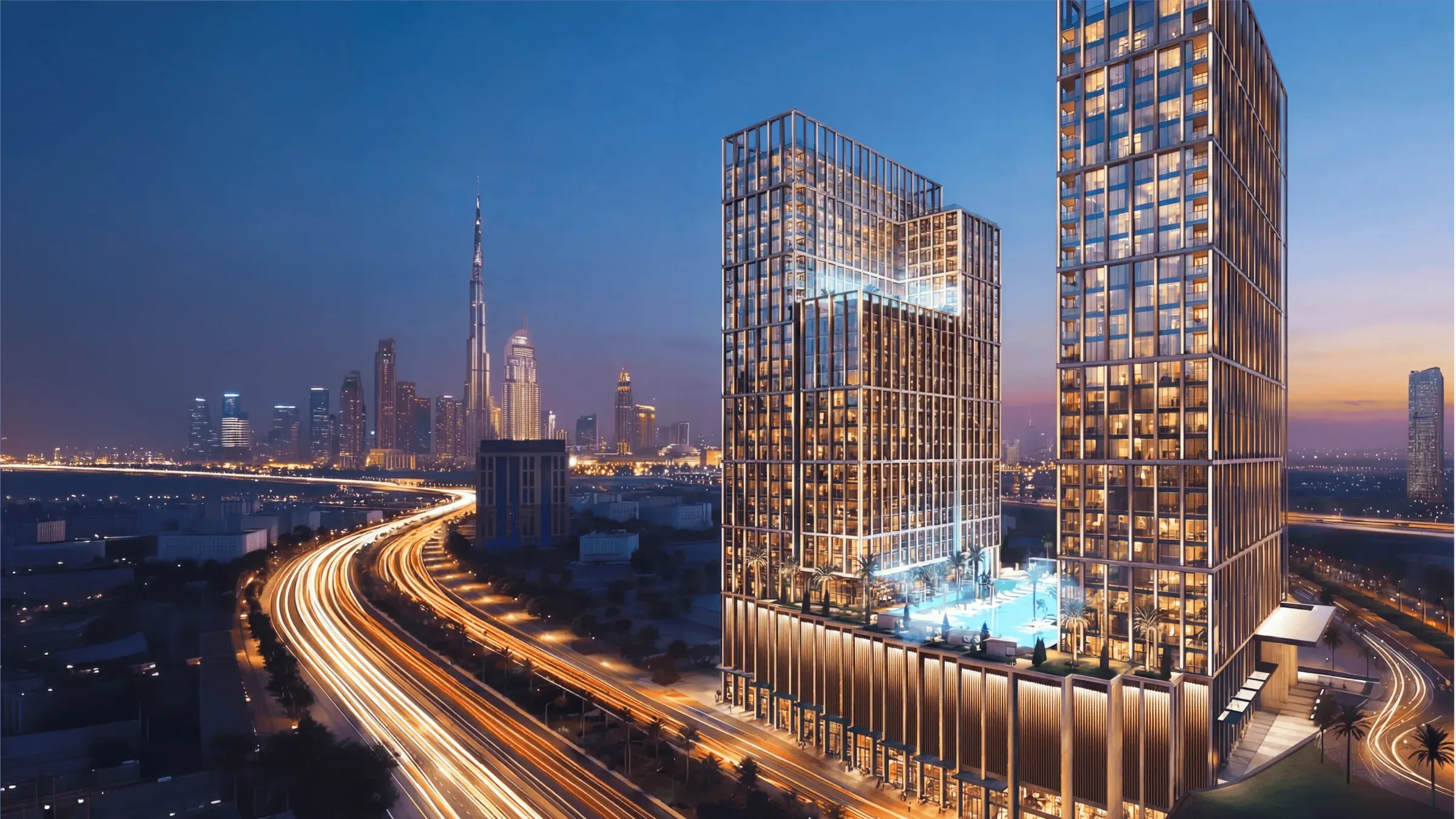
One of thirteen buildings in this section with primary stock still on sale, and the mixed-use case that shows why VAT apportionment matters — offices, retail and apartments in one tower are three different tax treatments. It is also the price trap: every portal quotes AED 774,999 for this tower, which is a studio apartment. The commercial rows are offices from AED 1.7M and ground-floor retail from AED 2.87M, both broker asking, 11 September 2026.

AED 1.7M offices from, broker asking Sep 2026
10/40/50 payment plan
Q4 2028 handover
View Project →
More about Binghatti Spectre
4

What comes off the rent before you see it

Service charge. Dubai Law No. 6 of 2019, Art. 25(a) puts the charge on the owner, payable to the management entity, and Art. 24 states that the owner is not released from it because a tenant did not pay. Law 26/2007 Art. 22 separately provides that, absent a contrary term, the tenant pays government charges for use of the property. Hence the usual commercial split — cooling and DEWA on the tenant, service charge on the owner unless the lease moves it — and hence the rule worth writing down: who pays which part of district cooling in a chiller-paid building is a question of contract, not of law.

On level: secondary sources put office service charges at AED 25–45+/ft²/year for Grade A and AED 15–25/ft² for Grade B/C, over a Dubai median of about AED 17/ft² from Mollak/RERA data covering 1,500+ buildings — which is residential-weighted and stands only as a proxy. The public source that does carry a project-level figure is the Mollak Service Charge Index, filterable by usage and budget year. That makes the charge verifiable before you sign.

The chiller line that catches people. District cooling capacity or demand charges are billed whether or not the unit is occupied. In a commercial lease, service charge, chiller capacity and chiller consumption have to be three separate clauses; conflating them is where most disputes during a void begin.

Void. An office tenant takes months to find, not weeks. There is also a commercial-only eviction ground worth knowing in both directions: Law No. 33 of 2008, Art. 25(1)(d) lets a landlord evict where business premises are left unoccupied without valid reason for 30 consecutive or 90 non-consecutive days in a year. As a landlord that is a lever; as an owner-occupier it is a constraint.

And the transactional costs, which are the same as residential and usually understated: DLD registration is legally 2% from the seller and 2% from the buyer plus AED 250 for the title deed and small knowledge and innovation fees, with a trustee fee of AED 4,000 + VAT above AED 500,000. The market convention that the buyer pays all 4% is a convention, not a rule — and in a commercial deal with a strong buyer the seller's 2% is genuinely negotiable. That is a rare piece of leverage and it is worth using.

Service charge, Grade A
AED 25–45+/ft²
Service charge, Grade B/C
AED 15–25/ft²
Vacancy grounds
30 days
5

Corporate tax: the company structure is often the more expensive one

The most common error in commercial-property advice aimed at foreign buyers is that you should hold Dubai commercial property through a company. For a pure rental strategy the reverse is frequently true, and the legislation says so directly.

Cabinet Decision No. 49 of 2023, Art. 2(2) (in force 1 June 2023) excludes three income types from a natural person's business activity regardless of amount: wage, personal investment income and real estate investment income — defined in Art. 1 as investment activity by a natural person relating to the sale, leasing, sub-leasing and renting of land or real property in the State that is not conducted, and does not require to be conducted, through a licence. The FTA's own guide on natural persons (CTGTNP1, 25 November 2023) works it through: §3.8.3 Example 15 has an individual letting several UAE properties for AED 1.2M a year and paying no corporate tax, and §6.1 Case 5 says such a person need not even register.

A company is a different taxpayer. Rental income at a legal entity is ordinary business income under Federal Decree-Law No. 47 of 2022: 0% up to AED 375,000 of taxable profit and 9% above it. The free-zone 0% regime for a Qualifying Free Zone Person exists, but its treatment of property income is narrow and tied to commercial property inside the zone, so it belongs with a tax adviser before any structure is chosen.

When is the company right? When you need entity-level credit, a partnership, a succession structure — or when the unit will house an operating business you run yourself. That last case is decisive: running a clinic or a restaurant in your own unit is licensed activity, so the real-estate-investment exclusion no longer applies to it.

Natural person
0%
Company, to AED 375K
0%
Company, above
9%
6

Liquidity: what you actually pay for the spread

Two points of extra gross yield in the secondary segment is not free money. It is compensation, and the four things it compensates for are measurable.

  • Depth. About 4,600 office transactions in the record year of 2025, against tens of thousands of apartment sales. On 10 August 2026 the entire Dubai office for-sale market on Bayut stood at 2,084 listings — the whole city.
  • Concentration. In the cheap segment the market is one building, not a district: every one of the 16 offices in Dubai priced under AED 500,000 on that date was in a single building, The Apricot in Dubai Silicon Oasis; the whole Dubai Investments Park office stock was one business park. Without comparables there is nothing to anchor a valuation to and nobody obvious to exit to.
  • Whole districts are closed. Dubai Media City, Dubai Internet City and Dubai Design District have no office freehold at all — they are TECOM free zones that lease and do not sell. Al Quoz, Dubai Production City and Dubai South simply had no office sale stock. Deira had three listings against 2,419 rental ones.
  • Longer voids, and a wider bid-ask. Both sides of most published «yields» in this market are asking prices. Where a portal publishes its own ROI it is often well below the arithmetic: Deira 3.68%, Bur Dubai 3.62% — only DIFC matched, at 9.46%.

One consequence to state out loud: the bigger the lot, the fewer the buyers. A 596 ft² suite sells into the band that accounts for two thirds of Dubai's office leasing. A full floor at eight figures sells to a much shorter list.

Read next: Grade A Offices: What Supports a Rental Premium — why Grade B rents grew faster than prime in Q2 2026, and why the premium for a fitted office ranged from −9% to +70% in buildings measured against themselves. Or see the buildings on the commercial section.

Related guide: Dubai Office Districts: A Map-Led Investment Guide — the same yield question answered district by district, with prices, rents and bands for twenty-seven of them.

Eaton Square
Meydan Horizon, MBR City

Eaton Square

The far end of the liquidity trade: one tenant per floor, 4.2 m floor to floor, and a ticket that narrows the resale audience to a handful of buyers. It is also a building of this size trading on broker asking prices, with its developer attributed differently by different sources.

AED 42M full floor, broker asking Sep 2026
70/30 payment plan
Q2 2028 handover
View Project →
More about Eaton Square

More commercial analysis

Get the Brochure

We'll send it to your WhatsApp shortly.