Commercial Analysis
Sep 24, 2026 13 min read

Retail Investment: Footfall, Tenant Quality & Lease Risk

Dubai's best retail is institutional and leased, not sold: Emaar's malls alone hold over 10.5 million square feet of GLA and returned AED 4.3bn of segment EBITDA in 2024, which is precisely why no unit in them is for sale. What an investor can buy is community and podium retail — 437 such deals went through in a single quarter. What follows is what that product is, the 2026 numbers behind it, the hospitality slump that any F&B case has to survive, and the alcohol rule that catches buyers who think they are purchasing a bar.

Retail Investment: Footfall, Tenant Quality & Lease Risk

The first thing to settle about Dubai retail is that the good stuff is not for sale, and not because of the price.

Emaar's own Integrated Annual Report 2024 puts Emaar Malls at over 10.5 million ft² of GLA including joint ventures, 3,500+ retail units, segment revenue of AED 5.1bn, EBITDA of AED 4.3bn and net profit of AED 3.2bn, with a weighted average lease expiry of about 3.1 years and 111 million+ visits to Dubai Mall in the year. An EBITDA margin of that order on recurring rent is not a development product; it is the asset itself. Selling units would hand away control of tenant mix, rent and valuation. So «buy a shop in Dubai Mall» is not a question of price. There is nothing there to buy.

What is available, what it is worth, and what it costs you in risk — including the two hard parts most retail copy skips, the H1 2026 hospitality slump and the alcohol licence — is what follows.

At a glance

What the retail market looks like in 2026

  1. 01 Mall units for sale Emaar Malls: 10.5M+ ft² GLA, AED 4.3bn segment EBITDA in 2024. Leased, not sold Held the asset is the rent roll, not the units
  2. 02 Strata retail deals Community and podium retail does trade, and briskly 437 AED 1.15bn, Q3 2025, CRC Property
  3. 03 Retail occupancy Vacancy 4.7%, down from 8.0% a year earlier (JLL Q2 2026) ≈98% CBRE Q2 2026
  4. 04 Retail leasing volume Down while occupancy is up — caution, on falling tourism (JLL) −14.2% q/q and −0.2% y/y, Q2 2026
  5. 05 Hotel occupancy After a record 2025 of 19.59M visitors and 80.7% occupancy −27.7pp H1 2026 y/y, RevPAR −31.8%
  6. 06 Alcohol tax Removed Jan 2023, extended to end-2024, reinstated — on retail and on-trade 30% back since 1 January 2025
1

What you can actually buy: strata and podium retail

The same concentration holds across the top tier. Dubai Retail (Dubai Holding Asset Management) consolidated 40+ assets in September 2025 — ten malls, fifteen lifestyle destinations, eighteen district centres — with 6,500+ retailers and over 13 million ft² of GLA, taking in Palm Jumeirah Mall, Ibn Battuta, Circle Mall, Dragon Mart, The Outlet Village, Bluewaters, JBR and Souk Madinat Jumeirah among others. Nakheel and Meydan were folded into Dubai Holding in 2024, so the fund is more concentrated than it was, not less. Majid Al Futtaim and Emaar hold the rest of the first tier.

What does trade is strata retail: the ground floors and podiums of residential towers and clusters in JVC, Business Bay, JLT, Dubai Marina, Arjan, Dubai South, Al Furjan and the Downtown podiums. Each unit has its own title deed and sells both off-plan and second-hand. The volume is real — AED 1.15bn across 437 retail sale transactions in Q3 2025 alone, up 95% quarter on quarter and 55% year on year (CRC Property).

The legal definition of what you are joining matters here. Under Dubai Law No. 6 of 2019, a «Unit» expressly includes a shop, an office and a warehouse — the law was written for mixed buildings. It also means your shop sits inside a jointly owned property run by a management company licensed and contracted through RERA, with an Owners Committee whose members RERA appoints. The old self-standing Owners Association is gone.

So «retail can't be bought» is true for the malls and false as a general statement. The second tier sells; the first tier holds.

Emaar Malls GLA
10.5M+ ft²
Retail units there
3,500+
Strata deals, Q3 2025
437
2

The market you would be buying into, Q2 2026

Four measured figures, and they do not all point the same way:

  • Occupancy ≈98% in Dubai (Abu Dhabi 95%), effectively unchanged year on year — CBRE, Q2 2026.
  • Vacancy 4.7%, down from 8.0% a year earlier, with the improvement driven by demand in secondary regional and small-format malls — JLL, UAE Retail Market Dynamics Q2 2026.
  • Rental growth ≈+3% year on year overall (CBRE), with super-regional mall rents +8.5% (JLL). The prime end is pulling away from the average.
  • Leasing volume −0.2% year on year and −14.2% quarter on quarter, which JLL attributes to caution against a background of declining tourism. Tenants are asking for flexibility and operational concessions; landlords are granting them selectively through performance-based terms.

Read together: space is full, headline rents are still rising, and new leasing has slowed. That is a market where an existing tenant is valuable and a vacant unit is harder to fill than the occupancy figure suggests.

One limit on all of it: absolute retail rents in AED/ft²/year by format — mall against community against street retail — are not published in open sources. Only growth percentages and occupancy are, so a mall-versus-podium rate quoted at you should arrive with the name of the report behind it.

Occupancy
≈98%
Vacancy
4.7%
Rental growth
≈+3% y/y
3

The hospitality number every F&B case has to survive

This is the paragraph most retail marketing leaves out, and leaving it out is a factual error.

2025 was a record year. Dubai's Department of Economy and Tourism recorded 19.59 million international overnight visitors, up 5% and the third consecutive record; average hotel occupancy 80.7% (78.2% the year before); ADR AED 579, up 8%; more than 154,000 rooms in 827 properties; and over 2 million visitors in December 2025 alone, a first. Dubai International remained the world's busiest airport for international passengers for an eleventh year.

Then H1 2026 happened. UAE hotel occupancy fell 27.7 percentage points year on year through June and RevPAR fell 31.8%, with CoStar's data — cited in CBRE's Q2 2026 review — recording that Dubai showed the sharpest declines. The wider forecast for the UAE economy in 2026 turned to a marginal contraction of −0.04% with recovery expected in 2027 (CBRE).

The response, and the expected recovery. Dubai issued two support packages totalling AED 2.5bn (AED 1.0bn plus AED 1.5bn, the second carrying 33 initiatives), including exemption from the Tourism Dirham and from fees on hotel-room and restaurant sales, and from event permit charges. Deloitte Middle East's Hassan Malik, quoted on 30 June 2026, put recovery at 3–6 months if flight schedules normalise.

Two things follow. First, «tourists are pouring in, so a restaurant unit is gold» is wrong for 2026 as stated — the correct version is «record 2025, a sharp H1 2026 dip, recovery estimated at 3–6 months», and an F&B model belongs stress-tested against the dip. Second, Dubai's own H1 2026 visitor numbers are not yet published, so any 2026 tourist figure quoted at you needs its source named.

2025 visitors
19.59M
2025 occupancy
80.7%
H1 2026 RevPAR
−31.8%
4

Alcohol: the licence belongs to the operator and the address, not to your unit

Four facts, in the order that changes decisions.

The 30% tax is back. Dubai's 30% municipal tax on alcohol sales was removed from January 2023 as an annual trial, extended to the end of 2024, and reinstated with effect from 1 January 2025 — applying to retail and to on-trade alike, notified through distributor African + Eastern and reported on 6 December 2024. Any guide still saying Dubai abolished the alcohol tax is wrong for 2026. The Dubai Municipality decision itself is not in open sources; the reinstatement is on the record through the distributor and the business press.

There is no published rule requiring a licensed venue to be inside a hotel. The official framing is that alcohol may be consumed only in the city's licensed restaurants, lounges and bars, with no hotel condition attached. The hotel association is administrative practice in how permissions are granted, not a citable regulation — and licensed venues without a hotel component demonstrably exist, in DIFC and in the Dubai Holding / Meraas destinations such as City Walk, Bluewaters and La Mer. Equally, no guide can promise that a given zone will grant one — that answer comes from the authority.

What that means commercially: an alcohol permission is the result of an administrative decision about a specific operator at a specific address. It is not a property of the premises and it does not transfer with the keys. Buying a retail unit «for a restaurant with a bar» does not buy the right to serve alcohol. Licence feasibility at that address belongs in the LOI or SPA as a condition, not on the list of things to work out later. It also means an F&B tenant's own licence history is part of their covenant strength, because if they leave, the permission leaves with them.

And one rule that applies to every restaurant, hotel ones included: Dubai Municipality prohibits the use of alcohol in food preparation — in force since 2010 and reissued in November 2024. Kitchens have moved to non-alcoholic substitutes. It affects menu design, which affects the concept your tenant can run in your unit.

Alcohol tax
30%, since 01.01.2025
Licence attaches to
operator + address
Alcohol in cooking
prohibited
5

The two buildings whose developers state the use

Against that background, two projects in this section are worth reading closely, because their developers do in writing what almost nobody in Dubai retail does — they say what the shop is for.

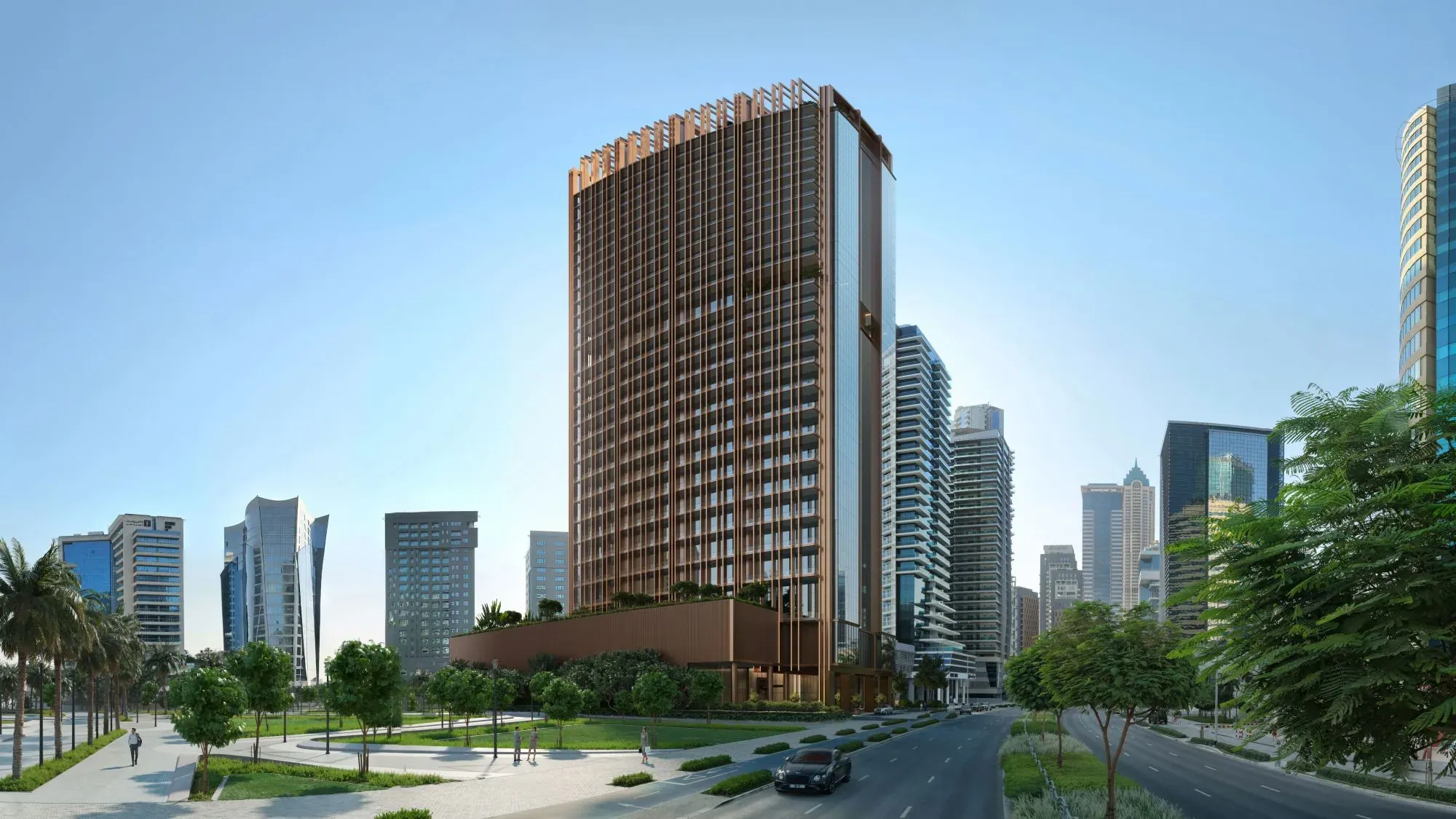
Burj Capital, Business Bay, is the clean citation. Centurion Properties gives the retail units their own specification block on its own project page — 5 units, 443–3,877 ft², fit-out shell & core — and inside that block, in its own words: «Designed with modern frontages and high footfall in mind, these spaces are ideal for luxury boutiques, cafes, and flagship stores seeking to make a statement in Dubai's dynamic retail scene.» Developer-hosted, inside a unit-type spec, naming three uses beside the unit count and the size range. The other column is emptier: Centurion publishes no retail price, so the strongest permitted-use evidence in this section sits on a lot you have to ask the price of.

The WOW Tower, DLRC, is the second. Mr. Eight Development's own FAQ answers it as a question — «Will there be cafes and restaurants?» — with «Four retail units are planned on the ground floor. The concept includes cafes, restaurants and lifestyle services for office users, residents and visitors», printed on both the residential and the office tab of wowtower.ae/faq and repeated in its Commercial Brochure under the heading «FOOD & BEVERAGE / AS PART OF DAILY LIFE», where it names Italian and Greek restaurant concepts. Read the tense: «planned», «designed to include», «envisioned». That is intent language, which is the most a developer can honestly offer before handover, and it is still worth more than a render. Here the price does exist — Mr. Eight's own availability list prices the four shops from AED 12,427,000 against 366 m², read 27 September 2026.

And the wording to watch on RAW DISTRICT. The «retail, F&B, service and boutique business concepts» line that circulates for its podium is a broker's, not Imtiaz's: it comes from a Bayut listing by Quik Sell Properties added 26 June 2026 — «Ideal for Retail, F&B, Boutique Stores & Service Businesses» — while Imtiaz's own RAW DISTRICT page on imtiaz.ae names no use at all, checked 27 September 2026. A broker's read of a podium is worth having. It is not a developer commitment.

RAW DISTRICT is still the cheapest thing in the sample, and that part stands. The priced lot is real: AED 2.5M against retail units of 999–1,046 ft², from the June 2026 launch price list as it was circulated to brokers, with the project page quoting «from 1,000 ft²» at the same price. The offices in the same building — 380–1,700 ft², entry AED 1.2M, at AED 853–2,095/ft² — are the cheapest office per foot in this section's Dubai sample. Three things travel with it. Completion is targeted Q1 2029 by Imtiaz and its brochure while Bayut records Q4 2029, and tower height and floor count are unconfirmed. The launch allocation, some AED 2bn, sold out on the day of release in June 2026, so the route in is resale or assignment and the schedule you step into is the original 20% on booking with 5% quarterly to 01/09/2028 and 50% on completion (a 60/40 post-handover version over three years was also offered at launch). And an F&B suitability, whoever states it, is not an alcohol licence — see the section above.

Burj Capital retail
443–3,877 ft², on request
WOW Tower retail from
AED 12.43M
RAW DISTRICT retail from
AED 2.5M
Burj Capital
Business Bay, canal-front plot

Burj Capital

The cleanest permitted-use citation in this section, and it is the developer's own: Centurion's project page gives its five retail units a specification block — 443–3,877 ft², shell and core — and says inside it that the spaces are «ideal for luxury boutiques, cafes, and flagship stores». A developer-hosted statement in a unit spec, not a caption. The catch is the other column: Centurion publishes no retail price, so the strongest evidence of use sits on a lot you have to ask the price of. And a suitability is not an alcohol licence.

on request retail — Centurion publishes none
5/35/60 developer-feed plan
Q4 2028 handover
View Project →
More about Burj Capital
6

The counter-example: where the use is still an open question

Binghatti Spectre is the counter-example, and it is here because the contrast is the lesson.

Binghatti's own project-facts sheet gives 19 retail units along the ground floor. The price circulating for them is AED 2,867,999, from a portal price list repeated across ten independent channels and checked on 11 September 2026 — broker asking, not a developer list. Binghatti keeps the retail documentation inside the sales process, so the permitted use for this podium stays an open question — ask us to put it to Binghatti directly. The 765 ft² the portals attach to that price appears in no official Binghatti document, so no per-foot rate is derivable here.

One more trap on this tower, because every portal falls into it: the headline AED 774,999 is a studio apartment. It is the cheapest residential unit in the building and it is not, under any circumstances, the price of a shop or an office there. A residential entry price standing in for a commercial one is the single most common misrepresentation in Dubai mixed-use marketing. Read the asset type beside a figure before you read the figure.

Retail from
AED 2.87M
Retail units
19
Permitted use
not stated
Binghatti Spectre
Al Jaddaf Waterfront

Binghatti Spectre

A waterfront Al Jaddaf address with nineteen ground-floor shops on Binghatti's own project-facts sheet, and one of thirteen buildings in this section with stock still on primary sale. Binghatti states no permitted use for the podium, so the F&B question stays open on it. The 765 ft² the portals quote with the price appears in no official Binghatti document, and the AED 774,999 those portals attach to this tower is a studio apartment.

AED 2.87M retail from, broker asking Sep 2026
10/40/50 payment plan
Q4 2028 handover
View Project →
More about Binghatti Spectre
7

Lease risk in strata retail

Six risks that come with the title deed. None of them is a reason not to buy; all of them are reasons to buy a specific unit instead of a category.

  • The tenant mix is nobody's job. A mall operator curates. In a strata podium nobody does — a second café can open next to yours, and you have no standing to stop it.
  • The anchor and the marketing are yours to build. Footfall is a function of how full the surrounding towers are, not of a leasing team's plan. In an off-plan podium that means your trade depends on the handover and occupancy rate of the residential above you.
  • The service charge is set without you. The management company's budget is approved by RERA — and under Law 6/2019 Art. 27 the management entity may charge owners nothing without RERA's prior approval, which cannot be given until an accredited auditor has verified the budget. Your influence runs through the Owners Committee, which forms once 10% of units are registered. You also cannot opt out: Art. 28 bars an owner from refusing approved charges or renouncing their share of the common areas to escape them.
  • Unpaid charges are a lien on the unit. Art. 32 gives the management entity a lien over each unit for outstanding service charges, states that «a Unit may not be disposed of unless these charges are paid», and allows a court to order sale by public auction after 30 days from a RERA-approved notice. On a second-hand purchase, the arrears position is a condition of the deal, not a detail. The building's own rate is publicly checkable in advance through the Mollak Service Charge Index, filterable by project and usage — a step for the checklist, not a question for the seller.
  • The Owners Association decides your tenant's kitchen. Extraction, grease trap, signage and trading hours are all subject to the management entity's consent, and for F&B they are not cosmetic — they determine whether the concept can operate at all.
  • Parking and exit liquidity. Visitor parking in a podium scheme is shared with residents and frequently short. And there are materially fewer buyers for a strata retail unit than for an apartment at the same price.

The permission chain your tenant has to clear, for a mainland restaurant: a DET trade licence with the restaurant activity, then layout approval and a food establishment permit from Dubai Municipality's Food Safety Department through the Food Watch system, then Person-in-Charge certification and food handler cards for staff, a HACCP-based food safety system under the Dubai Food Code, Dubai Civil Defence approval, and inspections before opening.

What kills more F&B deals than any regulator is the engineering: grease trap, extraction ducted to roof, DEWA capacity, drainage and a waste route. In a strata building each of those also needs the management company's agreement. If a unit is being sold to you as restaurant-ready, those five items are what «ready» has to mean.

8

The five checks before a retail reservation

  • Permitted use in the title, in writing. Under Law 6/2019 the use is fixed at register level, and changing it is an approval process with Dubai Municipality or the zone regulator, not a formality. Law 33/2008 Art. 25(1)(f) makes use contrary to the contract or to planning rules a ground for eviction.
  • The service charge from Mollak, for that project and that usage, for the current budget year — plus the arrears position on a resale.
  • Alcohol feasibility at the address, as a written condition, if the F&B case depends on it at all.
  • The engineering five: grease trap, extraction, DEWA capacity, drainage, waste route — and the management company's consent for each.
  • Who else is selling in the same podium, and what the residential above you hands over. Your footfall is their occupancy.

Where to next. The office side of the section starts with Dubai Office Market: Rents, Prices & Supply, and the net-return mechanics — VAT, service charge, corporate tax and liquidity — are in Commercial vs Residential: What Changes the Net Return. All twenty buildings, with their commercial prices, bases and dates, are on the commercial section.

Related guide: Sheikh Zayed Road Offices: Freehold Since 2025 — the two buildings whose retail is discussed above, in the districts the January 2025 freehold decision opened.

More commercial analysis

Get the Brochure

We'll send it to your WhatsApp shortly.